
From Notebooks to Data: Why Manual Pitch Counting is Failing Our Kids
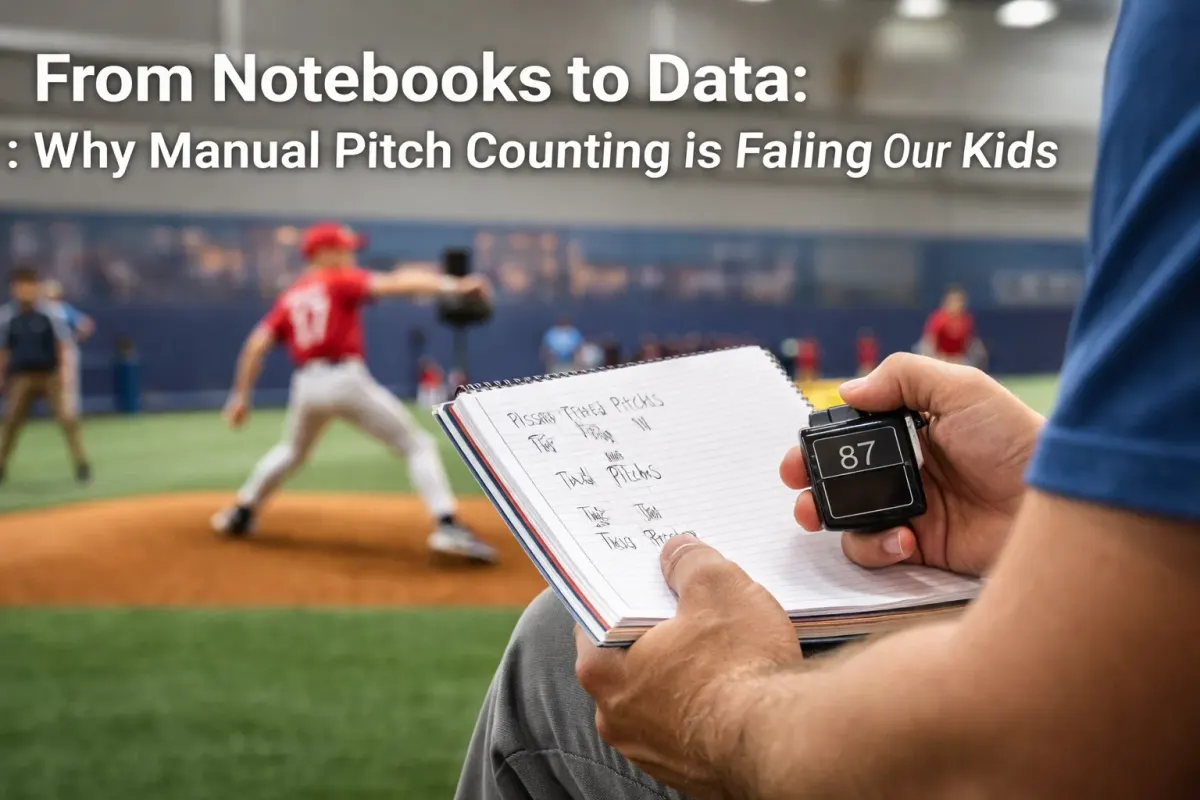
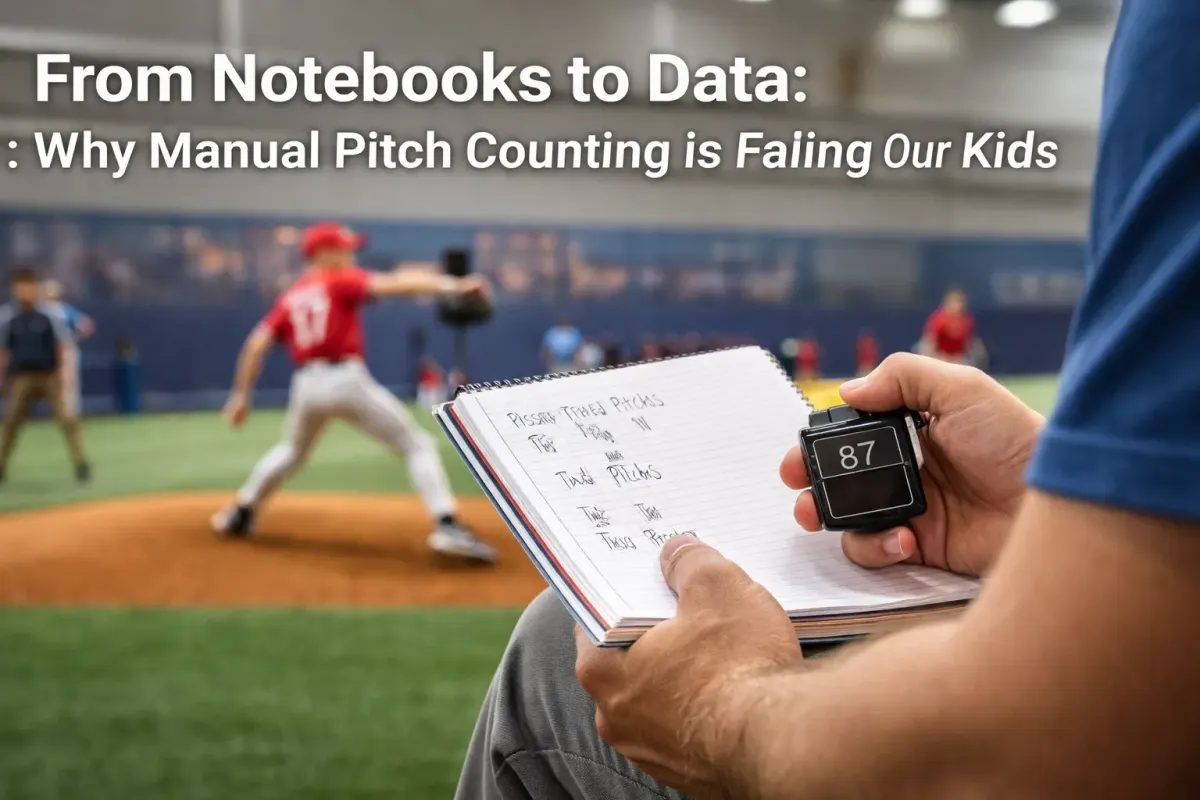
How many pitches did your kid throw last weekend?
If you're like most baseball parents, you probably have a rough idea. Maybe you scratched some numbers on a notepad during the game. Maybe you asked the coach afterward. Or maybe: let's be honest: you just hoped someone was keeping track.
Here's the problem: hope isn't a strategy when it comes to protecting your kid's arm.
Manual pitch counting has been the gold standard in youth baseball for decades. A designated scorekeeper with a clicker or notepad, tallying each pitch one by one. It sounds simple enough. But in my view, this system is fundamentally broken: and it's putting young arms at unnecessary risk.
The Reality of Manual Pitch Counting
Let's paint the picture. It's a Saturday tournament. Your 12-year-old is on the mound for the second time this weekend. The parent volunteer in the stands has a clicker in one hand and a hot dog in the other. Their attention drifts to their phone, to the other kids running around, to the conversation happening next to them.
Did that last one count as a pitch or a pickoff attempt? Was it 47 or 48?
This is the reality of manual tracking. It depends entirely on consistent human attention in fast-paced, distracting environments. And when the game gets intense: which is exactly when pitch counts matter most: accuracy often goes out the window.

The Multi-Team Problem
Here's where things get even messier. Most competitive youth players aren't just on one team. They've got:
- Their travel ball team
- Their school team
- Summer league
- Showcase events
- Private lessons with pitching coaches
Each one of these environments might be tracking pitches separately: or not at all. So when you ask "how many pitches did he throw this week?" you're piecing together fragments from different notebooks, different coaches, and different memories.
There is no single source of truth. And without that, all the pitch count guidelines in the world are basically useless.
Why This Matters More Than You Think
Organizations like Major League Baseball's Pitch Smart Committee have established age-appropriate pitch limits for a reason. Pitch Smart notes that research has shown pitch counts are the most accurate and effective way to limit a pitcher's workload (MLB Pitch Smart).
But here's the catch: those guidelines only work if the data is accurate.
When manual counting misses even a few pitches per game, those errors compound across a season. A pitcher who's supposed to max out at 75 pitches might actually be throwing 85 or 90 without anyone realizing it.
Over time, that hidden workload adds up. And suddenly you're sitting in an orthopedic surgeon's office wondering how things went wrong.
The Intensity Blind Spot
Raw pitch counts are just one piece of the puzzle. Manual tracking completely misses throwing intensity: which might be even more important for baseball injury prevention.
Consider this: a pitcher throwing 50 max-effort fastballs in a high-stakes playoff game is putting significantly more stress on their arm than one throwing 60 relaxed pitches in a blowout. But on paper? The second kid looks like the one who needs rest.
A recent study of 10- and 11-year-old players showed that a single arm-worn inertial sensor can count every throw in a game, not just pitches, while also quantifying throwing intensity (Freehill et al., 2023). That's the kind of data that actually tells you what's happening to a young arm.
Manual counting with a clicker? It can't come close.
The Digital Solution: What Modern Tracking Looks Like
Technology has caught up to this problem. Apps and digital platforms now provide real-time updates and comprehensive statistics that make manual systems look prehistoric.
What good digital tracking offers:
- Centralized data across all teams, coaches, and environments
- Real-time pitch counts that update automatically
- Historical tracking to spot workload trends over weeks and months
- Rest day recommendations based on actual data, not guesswork
- Shareable reports that parents, coaches, and trainers can all access
Imagine actually knowing: with confidence: that your kid has thrown 127 pitches in the last 7 days across three different settings. Imagine having that data in your pocket when a coach wants to push them for "just one more inning."
That's the power of moving from notebooks to data.
Building a System Around Your Athlete
At Major League Activation, I work with young athletes every day on sports performance training and recovery. And one thing I've learned is that the best outcomes come from complete information.
When I can see a pitcher's workload history alongside their movement patterns and muscle activation, I can provide truly customized sports therapy. I know which areas are likely under stress. I know when to push and when to pull back.
But when parents come in with scattered notes and best guesses? We're all flying blind.
The goal should always be informed decision-making: and that requires data you can actually trust.
What Parents and Coaches Can Do Right Now
You can start taking this seriously today, with or without an app. Here are some immediate steps:
- Designate ONE person to track pitches across all teams and settings
- Use a simple spreadsheet or notes app that syncs to the cloud
- Include warm-up throws in your counts: they add up
- Track rest days as carefully as you track pitching days
- Communicate with all coaches about total weekly workload, not just game pitches
And when digital solutions become available? Adopt them. The convenience factor alone will improve your accuracy dramatically.

When Prevention Isn't Enough
Even with perfect tracking, young arms still need support. That's where proactive care comes in.
If your athlete is showing signs of shoulder tightness or decreased performance, don't wait until something breaks. Muscle Activation Technique (MAT), used by pro and collegiate athletes, is designed to assess muscle imbalances and support range of motion by enhancing muscle function rather than just stretching things out.
Combined with our Shoulder Care program, we can create a comprehensive approach designed to support your young pitcher's arm health.
The bottom line: Good data leads to better decisions. Better decisions can support healthier athletes. And healthier athletes get to keep playing the game they love.
Frequently Asked Questions
Why is manual pitch counting unreliable?
Manual pitch counting relies on consistent human attention in distracting environments. Errors from missed pitches, miscounts, and lack of coordination between multiple teams compound over a season, leading to inaccurate workload data.
What are the risks of inaccurate pitch counts?
Inaccurate pitch counts can lead to hidden overuse, where young pitchers exceed safe workload limits without anyone realizing it. This increases the risk of arm injuries, including damage to the elbow and shoulder that may require surgery.
How can digital tracking help with baseball injury prevention?
Digital tracking provides centralized, accurate, real-time data across all teams and settings. This allows parents, coaches, and trainers to make informed decisions about rest and workload, which can help manage the risk of overuse.
What should I do if my young pitcher is already experiencing arm discomfort?
Don't wait for the problem to get worse. Call or text (360) 836-0107 to set up a time and get their movement and muscle activation assessed before a small issue becomes a big one.
Is pitch count the only thing that matters for arm health?
No. Throwing intensity, rest days, proper mechanics, and muscle function all play critical roles. That's why comprehensive tracking matters, and why some families also look at proactive care like MAT and Shoulder Care.
Serving youth athletes and families in Seattle / Bellevue / Eastside
Diamond Arm Lab replaces the notebook entirely — automated ACWR tracking built by a former MLB Athletic Trainer. Start free at diamondarmlab.com.
Individual results vary. This article is for educational purposes and is not medical advice. Talk with a qualified medical professional about your specific situation.