
How to Improve Your Range of Motion in 5 Steps (Easy Guide for Athletes Over 40)


Have you noticed that reaching overhead feels harder than it used to? Maybe your golf swing doesn't rotate like it did ten years ago, or getting out of a deep squat leaves you feeling like the Tin Man from The Wizard of Oz.
If you're an athlete over 40, you're not imagining things. Range of motion naturally decreases as we age: but here's the good news: it doesn't have to stay that way.
The problem is that most people either ignore the issue entirely or go about fixing it the wrong way. They stretch randomly, push through pain, or spend months in traditional physical therapy without seeing real results.
In this guide, I'll walk you through five practical steps to improve your range of motion—and explain why restoring muscle function and control is the real driver of flexibility. We'll also look at how Muscle Activation Technique (MAT) is designed to assess and address neuromuscular inhibition and imbalances to help your body access new range safely.
Why Range of Motion Matters More After 40
Before we dive into the steps, let's talk about why this matters so much for athletes in their 40s, 50s, and beyond.
Strength and flexibility both tend to decline with age. That's just biology. But here's what most people miss: losing range of motion isn't just about tight muscles. It's often about your nervous system shutting down certain movement patterns to protect you.
When muscles aren't firing properly, your body compensates. You start moving differently: sometimes without even realizing it. Those compensation patterns lead to:
- Decreased athletic performance
- Increased injury risk
- Chronic tightness that never seems to go away
- Joint pain that physical therapy doesn't fix
The key isn't stretching more—it's figuring out why you lost that range in the first place and restoring the muscle activation needed to control it. That's exactly what MAT is built to do.
Step 1: Commit to Daily Mobility + Control
Make this your baseline: 10–15 minutes a day, 5–6 days per week of controlled end-range work. You’re not just chasing “loose” muscles—you’re training your nervous system to own new positions.
- Joint circles/CARs: 30–60 seconds per joint (neck, shoulders, T-spine, hips, ankles). Move slowly, pain-free, and try to make each circle bigger without compensating.
- Controlled eccentrics: Sink into end range with a 4–5 second lower (e.g., split squat, calf lower, Jefferson curl light). 2–3 sets of 4–6 reps.
- Isometric holds at end range: 10–20 second contractions where you feel least stable (e.g., external rotation near end range, deep hip flexion). 2–3 positions per joint.
- Breathe and brace: 3–5 slow nasal exhales in an end-range position while keeping ribs stacked and core lightly engaged to teach your brain it’s safe there.
Key takeaway: Range of motion improves when you can contract and control it—not when you passively hang on tissues.
Optional: Light, short static stretches can provide temporary relief, but avoid long holds on muscles that feel “off,” weak, or unstable. If something doesn’t seem to fire, get assessed first so you’re not stretching an inhibited muscle. Muscle Activation Technique (MAT) is one assessment used by pro and collegiate athletes.
Step 2: Prioritize Full Range of Motion Over Heavy Weight
This one is tough for competitive athletes to hear, but it's critical: adapt your weights to maintain complete range of motion in every repetition.
Here's a practical example. A full-depth 200-pound back squat delivers more benefit than a shallow 225-pound rep. Every time.
When you sacrifice range of motion to lift heavier, you're actually reinforcing the movement limitations and compensation patterns that are causing your problems in the first place.
Signs you're lifting too heavy:
- You can't complete the full movement without "cheating"
- Your form breaks down in the last few reps
- You feel tightness or pinching at certain points in the movement
- You're consistently sore in areas that shouldn't be working hard
Check your ego at the door. Your joints will thank you.

Step 3: Incorporate Targeted Mobility Exercises
Targeted mobility with control is where real change happens. These movements help you earn usable range by improving muscle activation at end ranges—especially in areas that tend to lock up for athletes over 40.
Add these to your routine:
For Lower Body:
- Toe squats and lunges: Maintain flexibility in knees and ankles: critical joints that stiffen with age
- Deadlifts: Keep your hips and lower back mobile with 4-5 sets of 5-8 reps (remember Step 2: use appropriate weight)
For Upper Body:
- Y's and T's (with TRX or resistance bands): Target your anterior and posterior deltoids for better shoulder mobility
- Supermans: Strengthen your lower back and rear delts with 10-20 controlled reps
The key: Perform these movements slowly and deliberately. Speed is not your friend here. You want to maximize time under tension at the end ranges of motion.
If you're dealing with chronic shoulder tightness specifically, check out our guide on using Muscle Activation Technique and the Neubie to combat shoulder tightness.
Step 4: Use Active Recovery Techniques
Here's where most athletes over 40 go wrong: they either train hard every day or do nothing on their "rest" days.
Neither approach works well.
Active recovery: easy, low-impact movement: keeps you moving and helps maintain mobility without adding much training stress.
Great active recovery options include:
- Swimming or pool walking
- Light cycling
- Gentle walking or hiking
- Tai chi or yoga
- Light resistance training (using about 30% of your normal weight)
Aim for 1-2 active recovery sessions per week, lasting 20-45 minutes each. These sessions should feel easy. If you're breathing hard or sweating heavily, you're going too intense.
Step 5: Address the Root Cause (Not Just the Symptoms)
This is the step most people skip: and it's exactly why their range of motion problems keep coming back.
Stretching a muscle that isn't firing properly is like trying to stretch a rope that's been tied in a knot. You can pull on it all day, but until you untie the knot, nothing changes.
This is where techniques like Muscle Activation Technique (MAT) come in. MAT identifies which muscles aren't contracting properly and aims to restore their function. When your muscles are actually working the way they're supposed to, many athletes notice range of motion improving: sometimes in a single session.
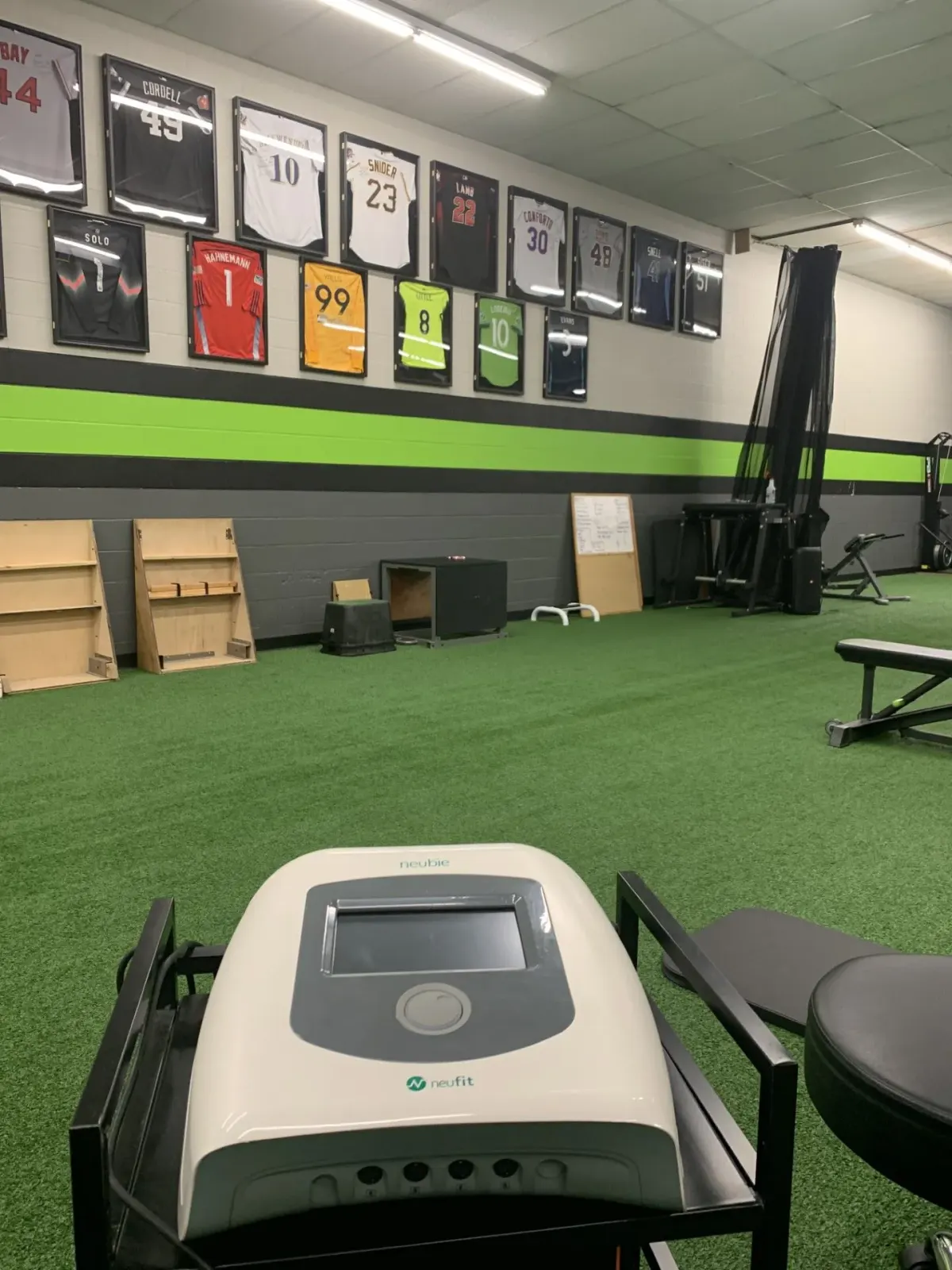
Similarly, Neubie electrical stimulation is designed to support neuromuscular re-education while you perform guided, active range-of-motion work. Instead of just forcing contractions, the Neubie is designed to help your nervous system relearn how to recruit the right muscles at the right time so you can control new range.
Why Traditional PT Often Falls Short
In my view, traditional physical therapy often focuses too heavily on the symptom (tight muscle, limited range of motion) without adequately addressing why that limitation exists.
You might stretch your hip flexors for months, but if the underlying issue is that your glutes aren't firing properly, those hip flexors will keep tightening up to compensate.
Red flags that your current approach isn't working:
- You've been stretching the same area for months with no lasting improvement
- Your range of motion improves temporarily but always returns to baseline
- You feel like you're constantly "fighting" your body
- Different practitioners keep finding the same problems
If any of these sound familiar, it might be time to look deeper than just the tight muscles.
Putting It All Together: Your Weekly Schedule
Here's a realistic framework for athletes over 40:
| Activity | Frequency | Duration |
|---|---|---|
| Strength training | 3-4 sessions/week | 45-60 minutes |
| Mobility + control (CARs, eccentrics, isometrics) | 5-6 sessions/week | 10-15 minutes |
| Targeted mobility work | 2-3 sessions/week | 15-20 minutes |
| Active recovery | 1-2 sessions/week | 20-45 minutes |
| Sports/enjoyable movement | 2-3 sessions/week | As desired |
Important: Many older athletes do better spacing hard sessions out with easier days in between rather than training hard 5-7 days in a row. Recovery is where the adaptation happens: don't shortchange it.
FAQs: Improving Range of Motion, Muscle Activation Technique, and the Neubie Device
How can I improve my range of motion after 40 without over-stretching?
Focus on daily mobility with control: joint circles/CARs, slow eccentrics, and end-range isometrics. This trains your nervous system to contract and control new range so it's more likely to stick.
What is Muscle Activation Technique (MAT) and how does it improve ROM?
MAT is a hands-on assessment and correction system that identifies neuromuscular inhibition (muscles that aren’t contracting well) and aims to restore function. When the right muscles fire, your body can stop compensating and your range of motion may improve. Learn more here: <https://majorleagueactivation.com/mat>
What does the Neubie device do during sessions?
The Neubie is designed to support neuromuscular re-education while you perform guided, active range-of-motion work. It aims to help your nervous system recruit the right muscles at the right time—with the goal of usable range and control. Details: <https://majorleagueactivation.com/neubie>
How quickly will I notice range-of-motion improvements?
It varies from person to person. Gains are more likely to last when you pair sessions with daily mobility and controlled end-range work.
Is passive stretching bad if I feel tight?
Not inherently—but it’s usually temporary relief. Avoid long static holds on muscles that feel weak or unstable. Get assessed first so you’re not stretching an inhibited muscle that actually needs activation.
Do I have to stop lifting heavy to improve ROM?
You don’t have to quit strength work. Prioritize full range of motion over load, adjust weights so form stays clean, and use tempo (slow eccentrics) and isometrics to build control at end ranges.
Ready to Stop Fighting Your Body?
Improving range of motion after 40 is absolutely possible. But it requires a smarter approach than just stretching harder or pushing through restrictions.
If you've been dealing with chronic tightness, limited mobility, or range of motion that never seems to improve no matter what you try, it might be time to address the root cause.
Call or text (360) 836-0107 to set up a time. In-person sessions available in Seattle, Bellevue, and the Eastside. We'll figure out what's actually going on and build a plan aimed at getting you moving better.
Individual results vary. This article is for educational purposes and is not medical advice. Talk with a qualified medical professional about your specific situation.