
The Workload Myth: Why Pitch Counts Alone Won't Save Your Arm
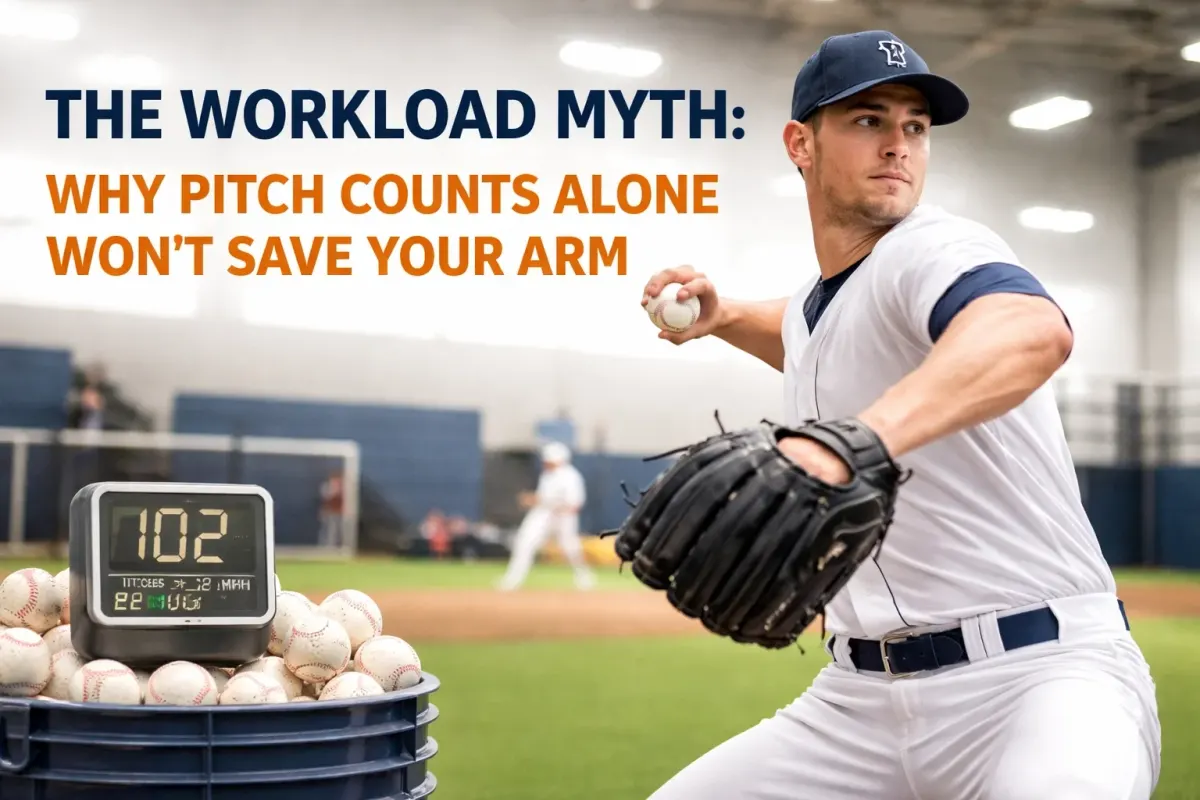
You hit your pitch count limit. You did everything "right." So why does your arm still feel like it's hanging by a thread?
Here's the uncomfortable truth that 19 years in professional baseball taught me: pitch counts create a false sense of security. They're not useless, but if you're relying on them as your primary defense against arm injury, you're leaving yourself dangerously exposed.
The game has evolved. The data has evolved. It's time your approach to pitching workload metrics and arm health evolved too.
The Problem With Counting Pitches (And Only Pitches)
Let me paint you a picture. It's game day. You throw 85 pitches. Your coach pats you on the back, nice, efficient outing. You stayed under the limit. You're good, right?
But what about the 30 warm-up pitches in the bullpen before the game? The 15 throws between innings? The long toss session yesterday that went a little longer than planned? The fielding practice where you made 20 throws across the diamond?
That 85-pitch game was actually closer to 150+ high-intent throws on your arm.
This is the workload myth in action. We've become obsessed with one number while ignoring at least half of the actual stress your arm experiences. And that hidden workload? It accumulates. It compounds. And eventually, it breaks something.
Why Pitchers Are Overpitched AND Undertrained
Here's something that might surprise you: many pitching injuries don't happen because arms are overworked, they happen because arms are underworked in training and overworked in competition.
Think about it. When was the last time you actually built arm strength outside of throwing a baseball? Modern training culture often treats healthy arms like injured ones, limiting long toss, restricting throwing volume, and essentially keeping your arm in a perpetual state of "protection."
The result? Arms that aren't conditioned to handle high-level pitching demands. Then we throw them into games and wonder why UCLs pop and shoulders break down.
The real issue isn't pitch counts: it's the mismatch between what your arm can handle and what you're asking it to do.
This is where understanding pitching workload metrics beyond simple counts becomes critical for baseball injury prevention.
Enter the Acute:Chronic Workload Ratio (ACWR)
If you want to actually protect your arm, you need to understand a concept that professional sports organizations have been using for years: the Acute:Chronic Workload Ratio.
Don't let the name intimidate you. It's simpler than it sounds.
Acute workload = What you've done recently (usually the last 7 days)
Chronic workload = What your body is used to handling (usually the last 28 days)
The ratio between these two numbers tells you whether you're in a safe zone or a danger zone. These ranges come from research in team sports like cricket, Australian football, and rugby league (Gabbett, 2016).
Here's How It Works:
- Ratio between 0.8 and 1.3 = Sweet spot. Your body can handle what you're throwing at it.
- Ratio below 0.8 = You're undertrained. Your arm isn't prepared for sudden spikes.
- Ratio above 1.5 = Red flag. You're doing way more than your body is conditioned for.
The most dangerous scenario? When a pitcher who's been throwing very little suddenly ramps up dramatically. That spike: not the total volume: is what tends to precede injuries.
In my view, this is the metric that should be guiding your decisions, not an arbitrary pitch count that ignores everything else your arm has been through.
How to Actually Spot Fatigue Before It Becomes an Injury
Here's where the rubber meets the road. Knowing about workload ratios is one thing. Actually catching fatigue before it turns into a torn UCL or shoulder impingement? That's the skill that saves careers.
Warning Signs You're Approaching the Danger Zone:
- Velocity drop – Even 1-2 mph consistently lower than your baseline
- Command issues – Especially missing arm-side when you normally don't
- Recovery time increasing – Needing an extra day to feel "normal"
- Grip strength changes – Difficulty maintaining your usual grip pressure
- Mechanical drift – Your body finding shortcuts because muscles aren't firing properly
Biomechanist Glenn Fleisig has said that for experienced pitchers, pitch counts should be "guidelines" rather than "rules," and that a pitcher with arm fatigue should come out, putting the real emphasis on spotting and managing fatigue (Baseball Prospectus). For youth players, he still favors firm pitch counts. When fatigue shows up, you stop. Period. You don't push through because you haven't hit some arbitrary number.
What We Do at Major League Activation When Workloads Get High
So what happens when you've pushed things too far? When the metrics are showing red flags and your arm is telling you something's off?
This is where Muscle Activation Technique (MAT) and the Neubie device can come into play.
Muscle Activation Technique (MAT)
MAT isn't about stretching or just loosening things up. It's about identifying which muscles have essentially "turned off" due to stress, fatigue, or overuse: and reactivating them.
When your workload spikes, your body starts compensating. Certain muscles stop doing their job, and other muscles pick up the slack. This compensation pattern can be a precursor to injury. MAT assesses these imbalances and aims to address them at the source, with the goal of improving your range of motion by enhancing actual muscle function.
For pitchers, this often means finding the weak links in your shoulder complex or hip that are forcing your arm to work harder than it should.

The Neubie Device
The Neubie takes this a step further by using targeted electrical stimulation to identify and address areas of dysfunction. It is designed to help "reset" the nervous system's relationship with overworked tissues.
Think of it as giving your body a software update after it's been running too many programs at once. The combination of MAT and Neubie is designed to support recovery and lets us step in early, while fatigue is still minor.
We've written more about this approach in our post on using MAT and the Neubie to combat shoulder tightness in baseball pitchers.
Building a Smarter System for Arm Health
Here's what an effective approach to baseball injury prevention actually looks like:
- Track everything – Not just game pitches. Bullpens, warm-ups, long toss, fielding throws.
- Calculate your ratio – Know where you stand week-to-week.
- Monitor fatigue signals – Velocity, command, recovery, feel.
- Build arm strength progressively – Don't just protect: prepare.
- Address dysfunction early – Tools like MAT and Neubie are one option before problems compound.
- Individualize everything – What works for one pitcher doesn't work for another.
Something New Is Coming
I'll be honest with you: tracking all of this manually is a pain. It's tedious. Most pitchers and coaches know they should be doing it, but the friction of logging everything and calculating ratios means it often doesn't happen consistently.
That's why we built The Diamond Arm Lab.
It's an app designed specifically to help pitchers track these metrics and manage workload more effectively. No more spreadsheets. No more guessing. Just a simple way to know where you stand and how your workload is trending, with the acute:chronic workload ratio calculated for you.
The Bottom Line
Pitch counts aren't worthless: they're just incomplete. If you're serious about arm health and longevity in this game, you need to think bigger.
Track your total throwing volume. Understand your acute:chronic workload ratio. Learn to recognize fatigue before it announces itself with a pop or a sharp pain. And when your body tells you something's off, address it with tools designed to work on the system rather than just mask symptoms.
Your arm is your livelihood. Treat it like more than just a number.
Ready to get ahead of arm problems before they sideline you? Call or text (360) 836-0107 to set up a time. We'll assess what's actually going on with your arm and build a plan designed to help keep you on the mound.
Individual results vary. This article is for educational purposes and is not medical advice. Talk with a qualified medical professional about your specific situation.